Nordic Walking After 60: A Joint-Friendly Cardio Upgrade
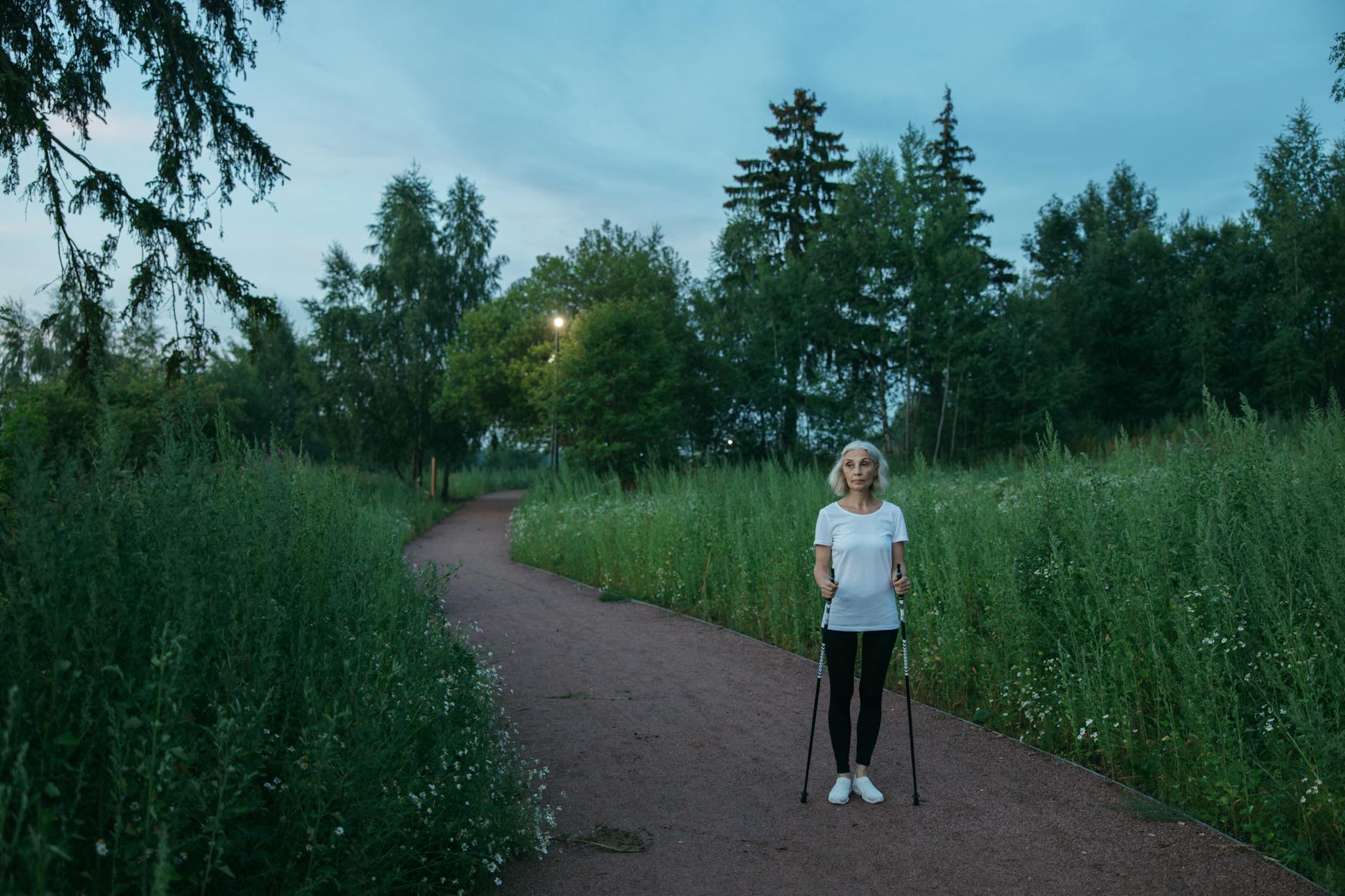
If you have ever spotted a group of cheerful sixty-somethings striding through your local park with what look like ski poles, you have seen Nordic walking in the wild. It is one of the few fitness trends to come out of Scandinavia that has aged extremely well, both literally and figuratively, and the research supporting it has grown noticeably in the last few years.
I'm Marischa, and I have been recommending Nordic walking to my clients for years, especially those who want more from their daily walks but cannot manage running. The pitch is simple: with two specially designed poles and a small change in technique, an ordinary walk becomes a near full-body workout. Heart rate goes up by ten to twenty percent for the same speed. Upper-body muscles wake up. Posture improves. And the joints, surprisingly, take less load rather than more.
This is a calm guide to what Nordic walking actually is, what the evidence says, and how to start without buying anything fancy.
What Nordic Walking Actually Is
Nordic walking originated as a summer training tool for cross-country skiers and gradually slipped into mainstream Finnish fitness culture in the 1990s. It uses two poles, slightly shorter than ski poles, with rubber tips for paved surfaces and removable spikes for grass and trail.
The technique is closer to skiing than to using trekking poles. You plant the pole behind you (not beside or in front of your foot), push down and back, and let the pole leave your hand briefly at the end of each stroke. Done well, the upper body works in opposition to the legs, much like a relaxed jog feels.
If that sounds technical, the good news is that the basics can be learned in a single forty-minute lesson. The British Nordic Walking association keeps a directory of instructors across the UK, and similar national bodies exist in most European countries. A single beginner's session is genuinely worth it; the difference between 'using poles' and 'Nordic walking' is real, and the technique change is what unlocks most of the benefits.
Why It Suits Women Over 60 So Well
A few reasons it lands well in our age group, in plain English:
- Lower joint impact than walking alone. Counter-intuitive, but true. Studies suggest the poles take 5 to 15 percent of body weight off the knees and hips with each step, depending on technique.
- More muscles working at once. Nordic walking proponents often note that a much higher share of the body's skeletal muscle is engaged when the technique is right, compared with standard walking, with the upper body taking a real share of the work.
- Higher heart rate without higher perceived effort. This is the magic. People feel like they are walking, but their heart rate is at a brisker level. Across multiple trials summarised by the Mayo Clinic Q&A on Nordic walking, the increase compared to a brisk walk has been consistent.
- Better posture cues. The poles encourage you to stand tall and lengthen the chest. Many of my clients with rounded shoulders find that a few weeks of Nordic walking does what a posture cushion never quite managed.
- Improved balance. Two extra points of contact with the ground help confidence on uneven paths, which matters in the autumn and after winter ice.
A 2022 systematic review on Nordic walking in older adults, indexed in PubMed, found consistent improvements in cardiorespiratory fitness, blood pressure, and functional walking ability across multiple trials. The effect sizes were not enormous, but they were real, and they tended to exceed those of standard walking programmes of the same duration.
What the Heart and Joints Get Out of It
The NHS exercise hub classes Nordic walking among the moderate-intensity activities recommended for older adults — efficient cardio that does not punish older joints. For women navigating osteoarthritis or simply a knee that has started talking back, that combination is rare. We discussed why low-impact options matter more after sixty in our piece on why low-impact exercise matters for older adults.
The Cleveland Clinic Nordic walking explainer flags one extra benefit that I think gets underweighted: the boost to upper-body strength. Most of us walk daily and never engage our shoulders, lats, or chest. Nordic walking quietly asks those muscles to work for an hour, and they thank you with better posture and easier shopping bags.
Getting Started: A Practical Plan
Here is how I usually suggest a beginner starts.
Step 1: Borrow or buy poles you can return
Do not invest heavily before you know you enjoy it. Many local outdoor shops and Nordic walking instructors lend poles for a first session. If you buy, the right length is roughly your height in centimetres multiplied by 0.66; a 165 cm woman would use a 110 cm pole, give or take 5 cm.
Step 2: Take one beginner lesson, in person if possible
Video tutorials exist and the NHS overview of walking for fitness mentions Nordic walking briefly, but the technique is hard to learn from screens. A forty-minute session with an instructor will save you months of half-Nordic, half-trekking confusion.
Step 3: Build slowly
- Weeks 1 and 2: 20 minutes, three times a week. Focus on rhythm and pole placement, not speed.
- Weeks 3 and 4: 30 minutes, three times a week. Add a small hill if your knees are happy.
- Weeks 5 and 6: 40 minutes, three or four times a week. Heart rate should rise enough that singing is hard but talking is fine.
Step 4: Pay attention to wrist straps
The straps are what allow the pole to leave your hand briefly at the end of each stroke. If your knuckles are white from gripping, you are working too hard with the hand and not enough with the back. Loosen the grip, trust the strap.
Common Mistakes I See
A few patterns crop up again and again with new Nordic walkers:
- Planting the pole in front of the foot. This turns it into a trekking pole and removes most of the cardiovascular benefit.
- Bending forward at the hips. Stand tall; the poles should pull your chest open, not collapse it.
- Death-grip on the handles. As mentioned, the strap does the work of holding the pole at the end of each stroke.
- Walking too fast too soon. Speed is the last thing to add. Technique, then duration, then pace.
A single follow-up lesson at week 4 catches almost all of these without any drama.
Who Should Be Cautious
Nordic walking is gentle for most people, but a few situations are worth flagging:
- Recent shoulder surgery or significant rotator-cuff pain. Speak to your physiotherapist first.
- Severe balance disorders or recent vertigo episodes. The poles help, but they do not replace stable footing.
- Wrist osteoarthritis with active inflammation. The wrist takes a small repetitive load that can flare a tender joint.
- Anticoagulant medication combined with a tendency to fall. The poles reduce the risk, but choose paths carefully.
None of these are absolute reasons to avoid Nordic walking. They are simply moments to take a careful first step rather than a confident one.
A Word on Community
The single most consistent thing I notice with clients who take up Nordic walking is that they end up in a small social circle around it. There is something about walking in a group with poles, in step, on a Saturday morning, that builds friendships faster than a gym ever does. Several women I have coached say the social side has done as much for their health as the cardio.
If you would like a quieter version, of course, going alone with headphones in is perfectly valid too. Both work. The poles do not mind.
Closing Thought
Nordic walking is one of the few exercise forms I would call genuinely under-promoted. It is cheap (a pair of decent poles costs about as much as a year of magazines), it is gentle on the joints, it is highly effective for cardiovascular health, and it tends to produce noticeable posture changes in eight to ten weeks. If you are already walking regularly and want to lift the ceiling without lifting the impact, this is, in my opinion, the most underrated upgrade available.
If you are not yet walking regularly, start there first. Our piece on whether walking alone is enough exercise in your sixties is a reasonable place to begin.